
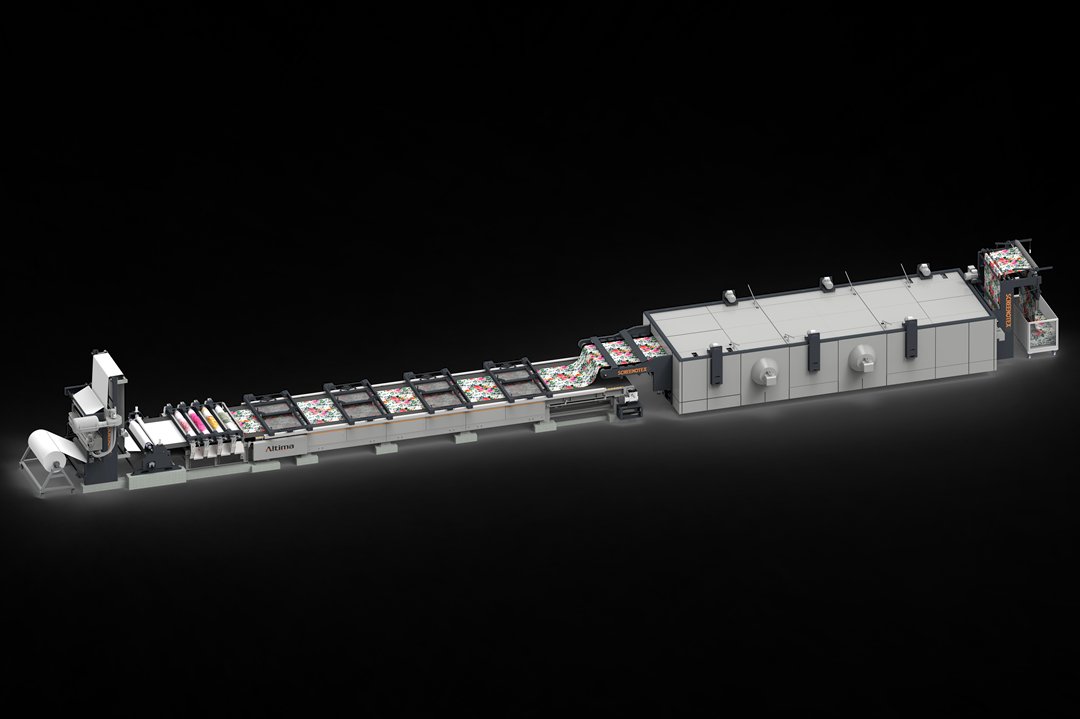
One machine. Two printing technologies. Switch between the high-speed continuous output of rotary screen printing and the critical design precision of flat-bed — without changing your production line.
Every print job has different requirements. Some demand the continuous speed of rotary. Others demand the fine line precision and high paste deposition of flat-bed. The Roto-Flat gives you both — on a single machine, selected by the operator before each production run.
A textile printing business typically needs both rotary and flat-bed capability. Some orders suit rotary — long runs, continuous designs, high throughput. Others suit flat-bed — critical designs, complex outlines, high paste volume, short to medium runs. Traditionally, meeting both requirements means buying and maintaining two separate machines.
The Roto-Flat changes that equation. A single machine frame houses both rotary and flat-bed printing sections, sharing the same blanket system, the same infeed and outfeed, and the same dryer connection. The capital cost of one machine. The floor space of one machine. The maintenance overhead of one machine. The production capability of two.
For mills looking to expand their print capability without doubling their capital commitment, the Roto-Flat is the most economically efficient path to running both technologies.
Switch to rotary mode for orders requiring maximum throughput. Continuous printing with no stop-start motion delivers significantly higher metres per hour than flat-bed on long runs — with consistent quality across the full production length.
Switch to flat-bed mode for designs that demand it — fine outlines, narrow lines, unlimited repeat lengths, and complex multi-colour work that cannot be achieved with rotary screens. Up to 12 heads for maximum colour range.
The Roto-Flat's design consumes less power than a dedicated full rotary machine of equivalent capacity — delivering cost savings on every production run regardless of which mode is in use.
A single machine replacing two reduces energy consumption, chemical usage, and waste across your production line — contributing to a lower environmental footprint without compromising output capacity.
Mode changes are controlled by an automated motorised blanket control system — not a manual mechanical process. The operator selects the mode; the machine configures itself accurately and repeatably every time.
Every feature on the Roto-Flat is designed around a single principle — that switching between two printing technologies on a single machine must be as seamless, reliable, and repeatable as operating either machine independently.
Our engineers will help you specify the right head count, rotary system, and configuration for your fabric range and production requirements.